News
October 28th, 2026 | 2-minute read
Students and Faculty Highlight Communication Disorders and Available Supports
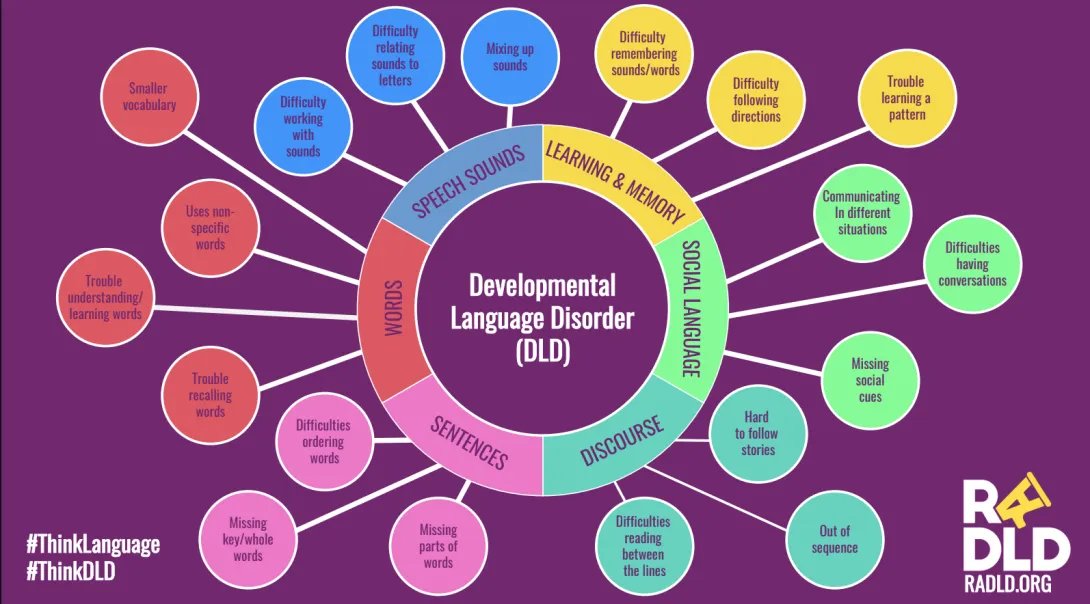
During Attention-Deficit/Hyperactivity Disorder (ADHD) and Learning Disabilities Awareness Month, and following Developmental Language Disorder (DLD) Awareness Day on October 16, Laurentian University is highlighting communication disorders and their impact on post-secondary students.

October 28, 2026 – During Attention-Deficit/Hyperactivity Disorder (ADHD) and Learning Disabilities Awareness Month, and following Developmental Language Disorder (DLD) Awareness Day on October 16, Laurentian University is highlighting communication disorders and their impact on post-secondary students.
According to Dr. Chantal Mayer-Crittenden, Associate Professor in Laurentian’s School of Speech-Language Pathology, approximately 10 percent of people live with a communication disorder. At Laurentian University, 7 percent of students experience language disorders, challenges that frequently overlap with learning disabilities and ADHD.
Communication disorders affect various aspects of spoken and written language, including comprehension, expression, grammar, vocabulary, reading, writing, and social interactions.
"Oral and written language is at the core of nearly all learning," explains Dr. Mayer-Crittenden. "At university, students must understand complex instructions, participate in discussions, and
write detailed papers. For students with language disorders, these requirements pose significant hurdles, yet these challenges do not reflect a lack of intelligence, motivation, or potential."
Some students develop strategies or use assistive technologies that make their difficulties less visible. Others reach university without a diagnosis or an explanation for why certain learning activities require additional effort.
Laurentian University’s School of Speech-Language Pathology plays a vital role in training future professionals to support individuals with communication needs across all life stages.
Students in the Orthophonie program connect knowledge from linguistics, psychology, science, and education with practical learning through dedicated laboratories, simulation spaces, and the on-campus Speech and Language Pathology Clinic. At the master’s level, clinical placements further develop students' assessment and intervention skills across diverse populations.
The program also drives international research. Dr. Mayer-Crittenden leads a longitudinal study on the acquisition of a minority language (French) in an Anglophone community, following cohorts of bilingual children and children with DLD to evaluate spoken and written language development in both French and English.
Dr. Mayer-Crittenden also collaborated with students, Gabrielle Héroux and Maria Falconi, on research presented at the International Developmental Language Disorder Research Conference. Both will graduate at Laurentian’s Fall 2026 Convocation and are now registered speech-language pathologists in Ontario.
To learn more about developmental language disorder and available support:
- Laurentian University Speech and Language Pathology Clinic: Provides clinical assessments and services (fees apply).
- Research & Publications: Learn more about Dr. Mayer-Crittenden’s research on minority language acquisition and DLD.
- First-Person Insights: Read A First-Person Account of Developmental Language Disorder to understand DLD through lived experiences.
- Global Resources: Visit Raising Awareness of Developmental Language Disorder (RADLD.org) or explore higher education resources from The DLD Project.
Continue reading

Student Voices Needed: Apply for Laurentian’s University Senate
Student leaders have long played a critical role in shaping Laurentian University. From influencing...
Oct. 26, 2026
Read more

Laurentian University Student and Alumnae Honoured with 2026 YWCA Young Woman of Distinction Award
Laurentian University is proud to celebrate first-year Sports Psychology student Leila Barsanti, who...
Oct. 23, 2026
Read more

Annual MineOpportunity Games Return to Laurentian with Record Attendance
MineOpportunity continues to inspire students across the north after 20 years
Oct. 21, 2026
Read more

Laurentian University Invites Future Students to Fall Open House
Laurentian University is pleased to announce its Fall Open House on Saturday, October 24, 2026, from...
Oct. 20, 2026
Read more

How the Helene Babin Jacob Bursary Empowers Master's Student Shincy Shaji
For Shincy Shaji, the path to advanced nursing practice has been defined by resilience, dedication, ...
Oct. 20, 2026
Read more
More to Explore
Explore Laurentian University

Study at Laurentian University

Browse Services and Support
