
Finance and Budget

This page contains all published Laurentian University financial reports, including budget reports, audited financial statements, audited pension statements, and other financial information.
These documents support our mandate to provide transparent financial information to the University community and to the public.
Plan of Compromise and Arrangement
The Plan of Compromise and Arrangement was negotiated with Laurentian’s creditors during insolvency in 2021. The purpose of the Plan was to restructure the University’s liabilities, allowing it to continue to operate.
Laurentian’s obligations under the Plan
Laurentian reached an important milestone in August 2025 in fulfilling its obligation under the Plan, when it completed the sale of the designated real estate properties to the Province of Ontario. The funds from this sale allowed Laurentian to fully fund the Distribution Pool under the CCAA Plan, which is used to pay back its creditors.
Laurentian continues to have ongoing obligations under the CCAA Plan, including to operate within an approved budget that is balanced, not undertaking capital projects or incurring expenses that would cause its financial position to become unstable, investing in various operational and governance projects (including the Transformation Program), and operating in a manner that ensures financial sustainability.
Exit Loan Agreement
During the CCAA process, the Province of Ontario provided Laurentian with a loan of $35M so that it could emerge from the CCAA proceeding with no other debt than the payments to be made to creditors from the proceeds of the sale of real estate. Through the Exit Loan Agreement, the Province became the University’s only lender. In so doing, the Exit Loan Agreement establishes a number of conditions the University must meet to help ensure that the $35M loan can be repaid, and that Laurentian will continue on its path of financial sustainability.
Some of the terms of the Exit Loan Agreement are listed below:
- The University had to develop a Strategic Plan, and update regularly to the Ministry of Colleges, Universities, Research Excellence and Security (MCURES) on the implementation of the Transformation project.
- The University must respect five financial covenants - essentially metrics of good financial health. Many of these can be satisfied by balancing the budget annually. The University reports on its projections with respect to the covenants on a regular basis, including in the budget.
- The University must file annually with MCURES a five-year Financial Forecast, including a Financial Usage Plan, which outlines how the University plans to spend its funds, together with the projected financial covenants. Once filed, any deviation from this Plan requires the permission of MCURES. Under this Plan, the University must put any budget surplus in its reserves, and cannot access the funds in its reserves without Ministry permission.
- The University cannot participate in any pension plan other than its current plan without Ministry permission.
Laurentian has until 2038 to repay the $35M loan, with interest. It is not permitted to repay the loan before November 2027. After this date, it can do so only with government permission.
Financial covenants
The Exit Loan Agreement also requires Laurentian University to meet six financial covenants annually – metrics of good financial health. These include:
- Have a debt service coverage ratio of not less than 1:1 (starting 2023-24)
- Laurentian must have enough money coming in to cover at least all its required debt payments (principal plus interest). Basically, cash flow must be strong enough to keep up with loan payments.
- Have a primary reserve ratio of not less than 30 days (starting 2025-26)
- Laurentian needs enough available savings or net reserves to cover at least 30 days of operating expenses, assuming no new revenues or funds were received.
- Have expendable net assets of not less than $0 (starting 2025-26)
- The value of resources Laurentian could actually use (after subtracting debts) must not be negative. In short, we cannot owe more than what we have available. The sum of unrestricted and restricted reserves or net assets cannot be negative.
- Have an in-year excess of revenue over expenses of not less than $0 (starting 2027-28)
- Each year, the University must at least break even — it cannot spend more than it earns in that year without counting on its accumulated reserves.
- Having a net income ratio of not less than 1.5% (starting 2027-28)
- Laurentian must make at least 1.5 cents in profit for every dollar it brings in. Revenues need to be slightly higher than expenses, leaving a mandatory contribution towards the reserve fund.
- Have a net operating revenue ratio of not less than 5% (starting 2027-28)
- At least 5% of Laurentian’s money from operations should be left over after covering operating expenses. This ensures a stronger financial reserve than just breaking even. For example, on a $200M budget, $10M would be the minimum reserve contribution.
Budget Reports
Budget Reports by Fiscal Year
Laurentian University’s consolidated budget is approved by the Board of Governors every year in April.
It is posted publicly on this website following approval.
Quick Facts About the 2026-27 Consolidated Budget
Projected Student Enrolment for 2026-27*
Domestic
| Domestic Undergraduate | 5,019 |
| Domestic Graduate | 558 |
| Total Domestic | 5,577 |
International
| International Undergraduate | 224 |
| International Graduate | 498 |
| Total International | 722 |
Total
| Projected total student enrolment: | 6,299 FTE |
| Projected undergraduate domestic enrolment: | 5,019 FTE |
| Projected graduate domestic enrolment: | 558 FTE |
| Projected undergraduate international enrolment: | 224 FTE |
| Projected graduate international enrolment: | 498 FTE |
| Total capital spending (infrastructure and deferred maintenance): | $8.4M |
| Outstanding principal on the Exit Loan Agreement: | $28.0M |
| Projected year-end position: | Excess of $2.7M ($1.4M after accounting gain on sales) |
*as of April 1, 2026.
Projected Revenues and Expenses by Source for 2026-27*
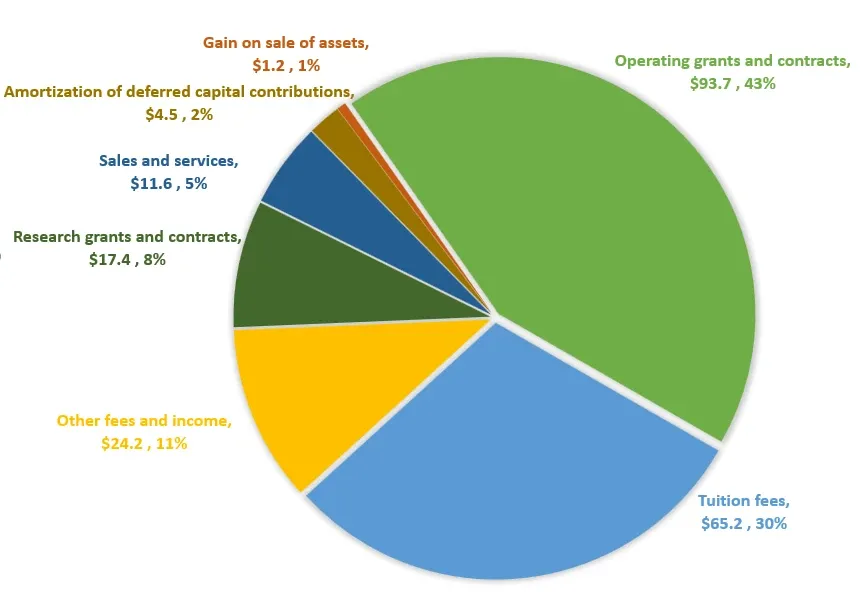
Projected Revenues by Source for 2026-27
| Total projected revenues (in millions): | $217.8M |
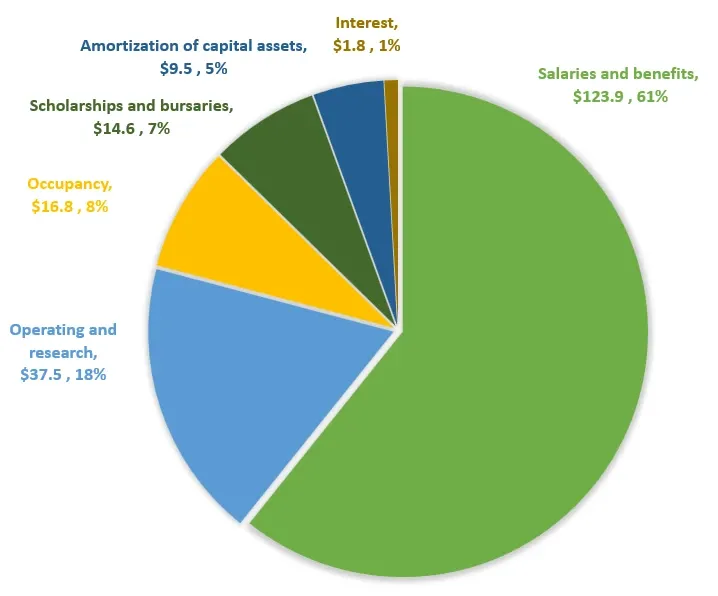
Projected Expenses by Source for 2026-27
| Total projected expense (in millions)s: | $215.1M |
*as of April 1, 2026.
Laurentian’s Consolidated Operating Budget
The budget book presents Laurentian’s consolidated budget, which combines financials from its operating and research activities, ancillary services, and capital maintenance. Together, these components provide an overall view of Laurentian’s financial position and the resources required to support its academic mission, research activities, and campus operations. MIRARCO and its share of SNOLAB results are also included in the consolidated budget as related entities.
The operating budget represents the majority of expenses, on average, approximately 80%. The Operating Fund includes the resources available for teaching, student services, and academic and administrative support. The operating budget is divided into budgetary units, each of which is responsible for managing the financial activities of its department.
The Ancillary Fund includes non-academic units providing services that enhance campus life and support Laurentian’s academic and research mission. Each ancillary service is required, at a minimum, to be financially self-sustaining. This includes units such as Residence Life, Dining Services, Print Hub, and Parking Services. The ancillary budget is approved separately by the Board earlier in the year and is included in the consolidated budget.
The Capital Fund supports renovations to existing spaces, deferred maintenance projects, and major capital assets. These investments may be funded through government grants, internal operating resources, and other sources designated for capital purposes.
The Research Fund includes externally restricted research funds, as well as internally designated funds that support research and scholarly activities. Future funds for which activities are not reflected in the operating budget include endowed and special-purpose donations.
How Laurentian’s Budget Works
Laurentian’s financial sustainability depends on ensuring that costs do not exceed revenues. Our revenues come primarily from provincial operating grants, which represent about 43 per cent of total revenue; student tuition fees, which represent 30 per cent of total revenue; ancillary services such as revenues from residences, food services, and parking; and also research grants.
Our costs are largely driven by salaries and benefits, as well as operating and research costs, occupancy costs, and scholarships and bursaries. Our costs are inherently inflationary, meaning that they go up every year. This includes salary increases, utilities, and ongoing expenses associated with maintaining our buildings, among other things.
Since our costs increase every year, our revenues - especially our student enrolment - must grow at a similar rate in order to maintain a balanced budget. When enrolment projections do not support that level of growth, we must adjust the budget accordingly to ensure that it remains balanced.
Laurentian’s Reserves
A reserve is an accumulated surplus. It increases at the end of a fiscal year when operating revenues cover all expenses for the year. These are presented as ‘Net Assets – Unrestricted and Internally Restricted’ on the Statement of Financial Position in the budget report.
As with any university, Laurentian’s reserves act as its ‘savings account’. This fund can be used to support special projects, to pay for infrastructure projects or renovations, or for other one-time purposes.
Since Laurentian cannot borrow money, reserves are especially important as they become the only source of funding for unexpected costs. This means that any unexpected event – from failing electrical infrastructure, to a broken pipe, or a significant decline in enrolment – must be funded internally. Laurentian’s reserves ensure the University can continue to operate and pay employees if something negatively affects our revenues or costs.
Importantly, reserves are ‘one-time money’. Once the money has been spent, it is gone. As a result, the University cannot use reserves to fund costs that recur on an annual basis, such as salaries.
As outlined in the Exit Loan Agreement, any excess over revenue that Laurentian generates must be placed into its reserves.
Types of reserves
Laurentian’s reserves are made up of two types: restricted and unrestricted.
‘Internally Restricted Net Assets’ are funds set aside and approved by the Board of Governors for specific, designated future purposes, such as capital projects or the Transformation program, or funds received for future purposes such as research grants. These funds are not available for general spending.
‘Unrestricted Net Assets’ are not currently committed and can be used for a variety of one-time purposes. Unrestricted reserves are the only savings that can be used to cover one-time, short-term operational financial gaps. Access to these unrestricted funds is necessarily limited, because they represent the University’s only reserve in the case of deficits or other financial challenges.
Accessing reserves
As a requirement of its restructuring, Laurentian cannot access its unrestricted reserves without approval by both the Board of Governors and the provincial government.
Statements

Consolidated Financial Statements
Laurentian University’s consolidated financial statements are audited by the University’s external auditors and presented to the Board of Governors for approval each fall.
They are posted online following approval.
They are posted online following approval.

Audited Pension Statements
The audited pension statements are approved by the Board of Governors annually in December.
The filing on an annual basis of the audited financial statements is required under the regulations governing retirement plans registered in Ontario.
The filing on an annual basis of the audited financial statements is required under the regulations governing retirement plans registered in Ontario.
Collective Agreements
Laurentian University Faculty Association (LUFA)
Expiring June 30, 2028
Laurentian University Staff Union (LUSU)
Expiring June 30, 2027
Canadian University of Public Employees (CUPE) (representing graduate teaching assistants)
Expiring June 30, 2026