News
May 28th, 2026 | 3-minute read
Laurentian University Student Shauna Heron Pioneers Emotion-Adaptive Artificial Intelligence for Mining Safety
Shauna Heron, a Master’s candidate in Clinical Psychology at Laurentian University, has completed groundbreaking research into human-robot trust to advance industrial safety. Backed by the IAMGOLD President’s Innovation Fund—a strategic partnership established to inspire next-generation mining solutions and foster workplace safety—the study investigates how people form trust in collaboration with an autonomous robot that is responsive to human mental states versus one that is not . Her co-authored research paper is currently available as a peer-reviewed preprint on the open-access repository ArXiv.

(May 28, 2026) — Shauna Heron, a Master’s candidate in Clinical Psychology at Laurentian University, has completed groundbreaking research into human-robot trust to advance industrial safety. Backed by the IAMGOLD President’s Innovation Fund—a strategic partnership established to inspire next-generation mining solutions and foster workplace safety—the study investigates how people form trust in collaboration with an autonomous robot that is responsive to human mental states versus one that is not. Her co-authored research paper is currently available as a peer-reviewed preprint on the open-access repository ArXiv.
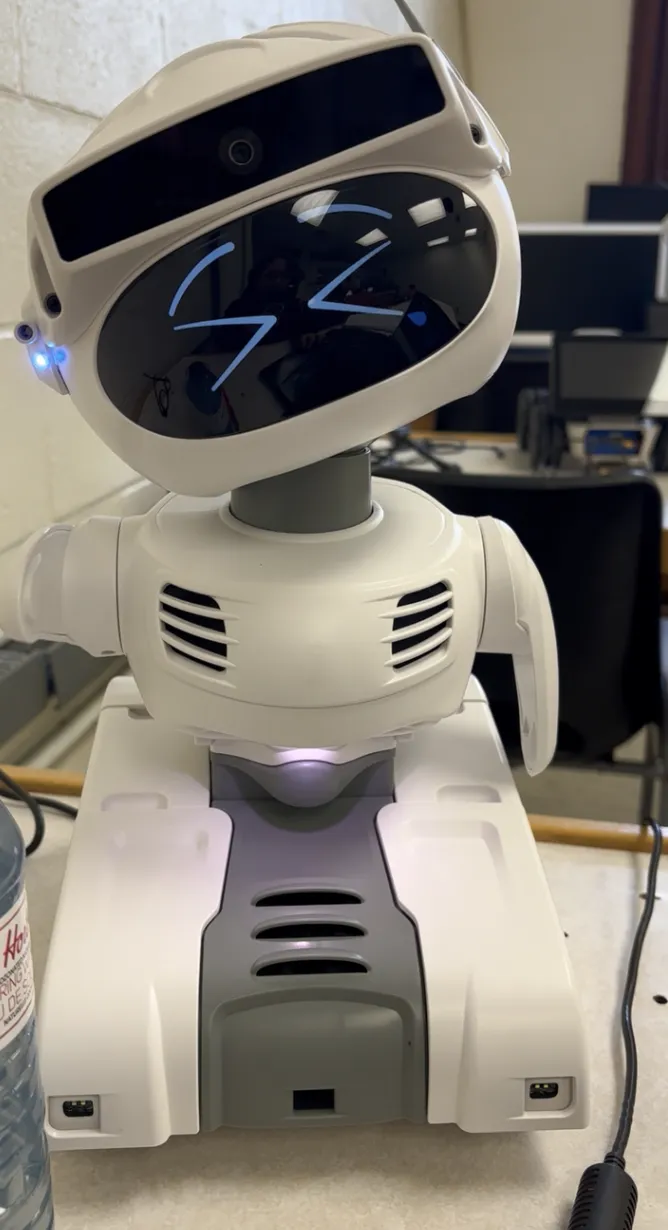
Traditional industrial robotics focus almost entirely on routine mechanical tasks. Heron’s research explores what happens when robots become collaborative partners capable of spoken dialogue, real-time adaptation, and social interaction. Using the expressive Misty II robot platform, Heron built an autonomous dialogue loop that used a series of large language models to infer human frustration, confusion, or engagement from speech, allowing the robot to adapt its facial expressions, physical movements, and verbal responses in real time while helping participants complete several collaborative tasks.
The comparative testing revealed a fascinating psychological trend: worker trust was not determined by the operational accuracy of the machine.
"I think the most surprising finding was that trust in the robot was not tied to how well it performed in terms of successfully helping the user answer the questions accurately," Heron notes. "In other words, even when their answers were wrong, participants still tended to rate the responsive robot as more trustworthy than the control robot. This suggests that trust is not just about competence or reliability in task performance, but also about the quality of the interaction and the robot’s ability to engage with the user’s emotional state."
While a humanoid robot will not navigate subterranean mine tunnels tomorrow, this technology can transform the voice and screen interfaces that industrial operators use daily. An emotionally intelligent system can detect operator fatigue, stress, or confusion, allowing the interface to adapt how information is delivered. Instead of firing off standard, repetitive alerts, a responsive system can slow down, highlight critical data, or explicitly call for emergency assistance.
Heron credits much of her academic journey to her graduate supervisor, Doctor Emond, who mentored her since her undergraduate degree and successfully advocated for her interest in moving from a clinical focus to experimental psychology. This foundational support allowed her to take advanced computational courses and ultimately connect with Doctor Lau to supervise this project.
Shauna Heron credits the IAMGOLD President’s Innovation Fund with making the study possible and funding the Misty II robot platform. On a personal level, completing this pilot study has profoundly altered her professional trajectory:
"Working on this research is what pushed me to consider a PhD in engineering with a focus on human-robot interaction — bringing the psychological side of this work, trust, affect, and human factors, into an engineering research program," Heron explains. "My goal is to continue this work in Doctor Lau’s lab, where the infrastructure and expertise to push it further already exists. That’s not a small thing — a pilot study funded by the IAMGOLD innovation grant setting the direction for a research career!"
The next phase for Heron is to defend her psychology thesis and afterwards working within the Laurentian Intelligent Mobile Robotic Laboratory mapping out a larger, robust confirmatory study featuring sophisticated multi-modal sensing capabilities, such as facial expression and body language detection.
Continue reading

Accessibility Support During ADHD and Learning Disabilities Awareness Month
October marks Attention-Deficit/Hyperactivity Disorder (ADHD) and Learning Disabilities Awareness Mo...
Oct. 19, 2026
Read more

Laurentian University Previews 12th Year of Intercultural Ride-Along Initiative
As community partners prepare for the 2026–27 cohort of the Intercultural Ride-Along and Job Shadow ...
Oct. 15, 2026
Read more

Laurentian Welcomes Fall 2026 Faculty Cohort
Laurentian University is welcoming new professors this fall with the addition of nine faculty member...
Oct. 14, 2026
Read more

Laurentian Earth Sciences Student Shares Impact of Donor Support and Marsh A. Cooper Award
For Inelia Garand, an undergraduate student at Laurentian University’s Harquail School of Earth Scie...
Oct. 13, 2026
Read more
News
Laurentian University closes 2025–26 fiscal year in stable position, launches 2027–2028 budget proce...
Laurentian University has officially closed its 2025–2026 fiscal year, with the institution continui...
Oct. 09, 2026
Read more
More to Explore
Explore Laurentian University

Study at Laurentian University

Browse Services and Support
