News
September 2nd, 2026 | 3-minute read
Laurentian Student Shivani Gami Represents School of Natural Sciences at Global Forensic Genetics Conference
Growing up in Kenya, Shivani Gami spent hours watching crime dramas like Bones, fascinated by the idea of using biology to solve mysteries. What began as a childhood fascination eventually developed into an academic pursuit that brought her to Canada at age 18 and, most recently, to an international stage in forensic genetics.

September 2, 2026— Growing up in Kenya, Shivani Gami spent hours watching crime dramas like Bones, fascinated by the idea of using biology to solve mysteries. What began as a childhood fascination eventually developed into an academic pursuit that brought her to Canada at age 18 and, most recently, to an international stage in forensic genetics.
Today, as a Master of Forensic Sciences (MFS) student at Laurentian University, Gami is helping advance emerging approaches to forensic deoxyribonucleic acid (DNA) profiling.
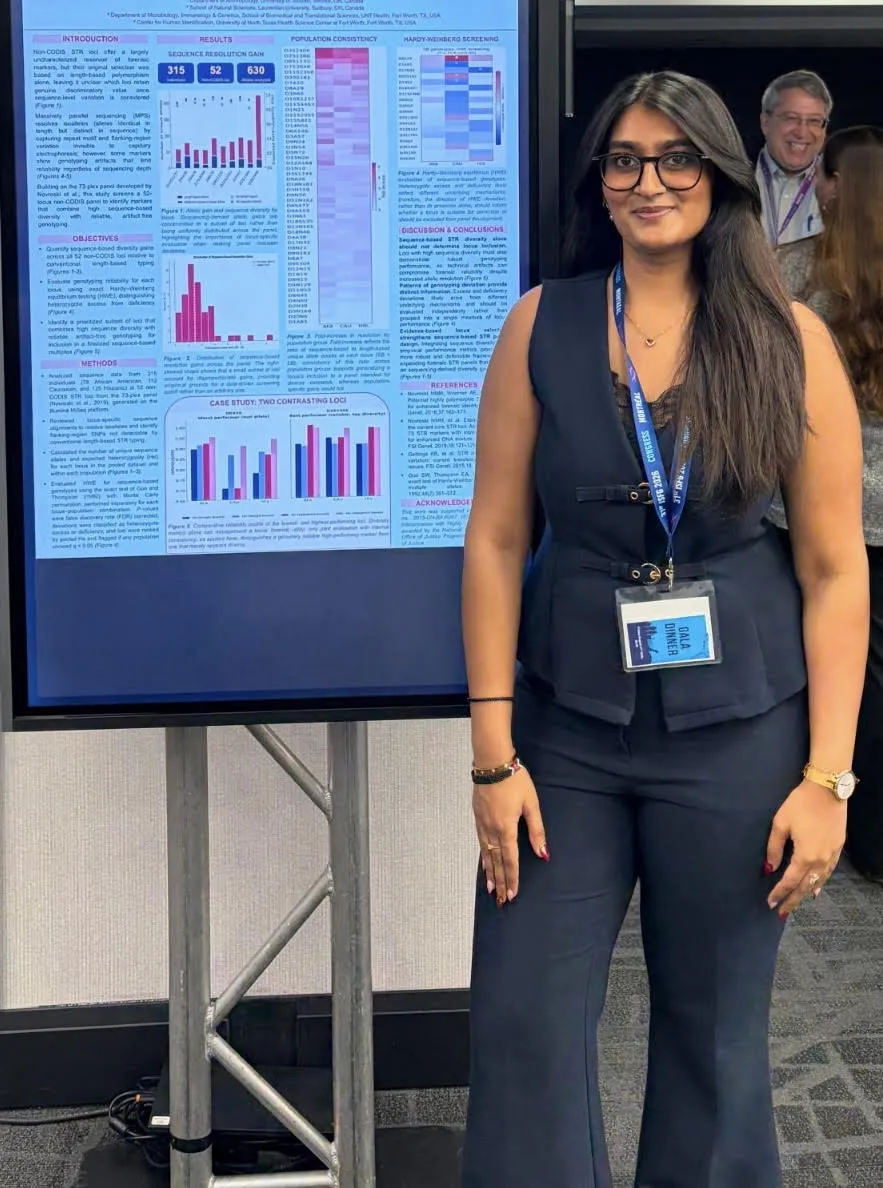
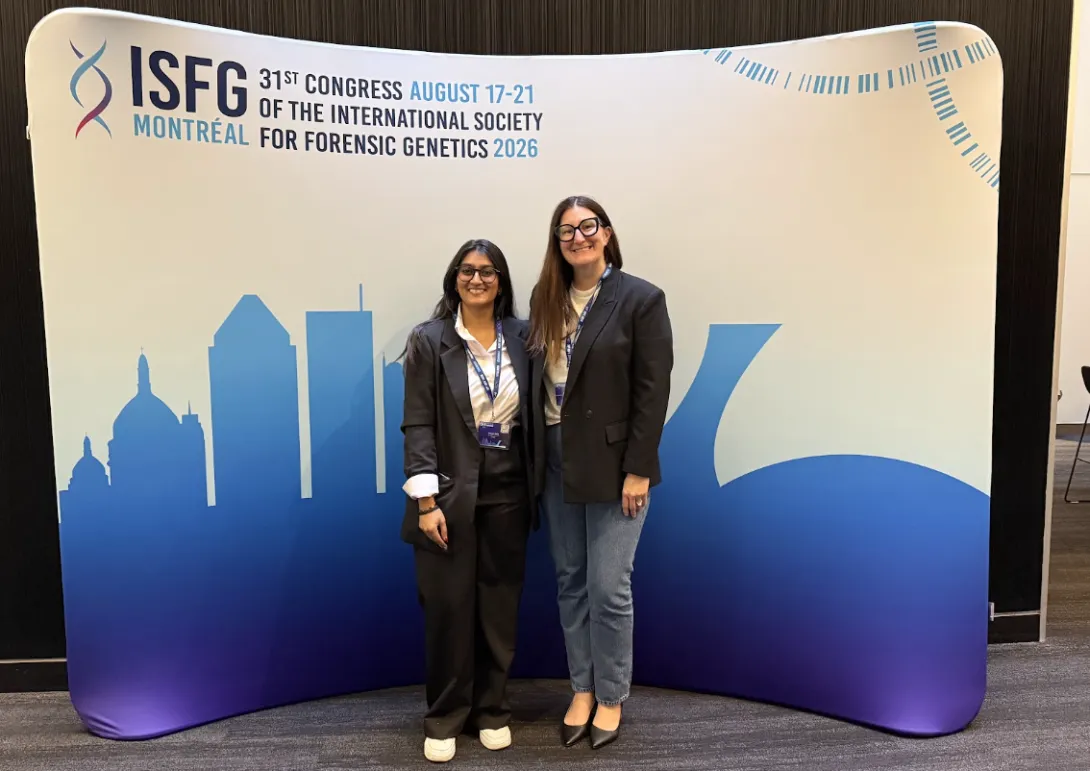
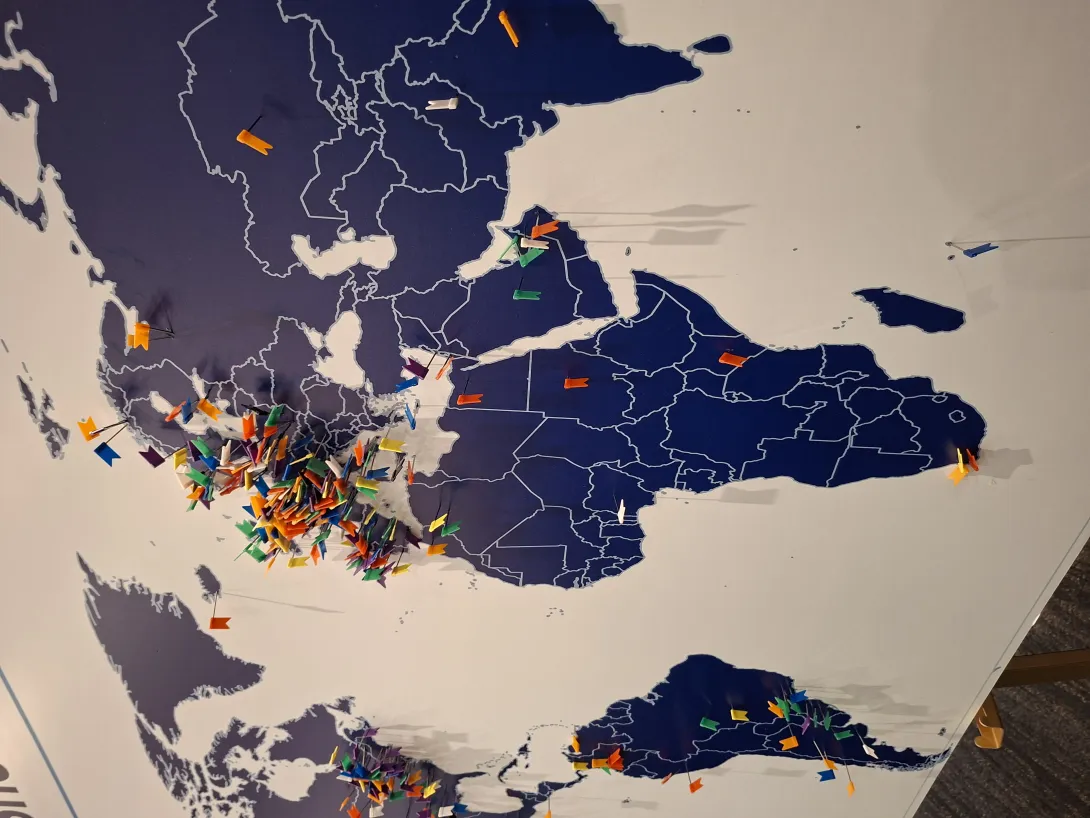
Gami recently presented her cutting-edge thesis research in Montreal at the 31st Congress of the International Society for Forensic Genetics (ISFG), joining researchers and practitioners from around the world at the premier global meeting for forensic DNA experts.
Her journey to Laurentian’s School of Natural Sciences reflects a drive to explore new frontiers. Moving from Kenya to Canada on her own to pursue her passion, Gami completed her undergraduate degree at the University of Toronto, where she first discovered her love for hands-on wet lab work, before choosing Laurentian for her graduate degree programme.
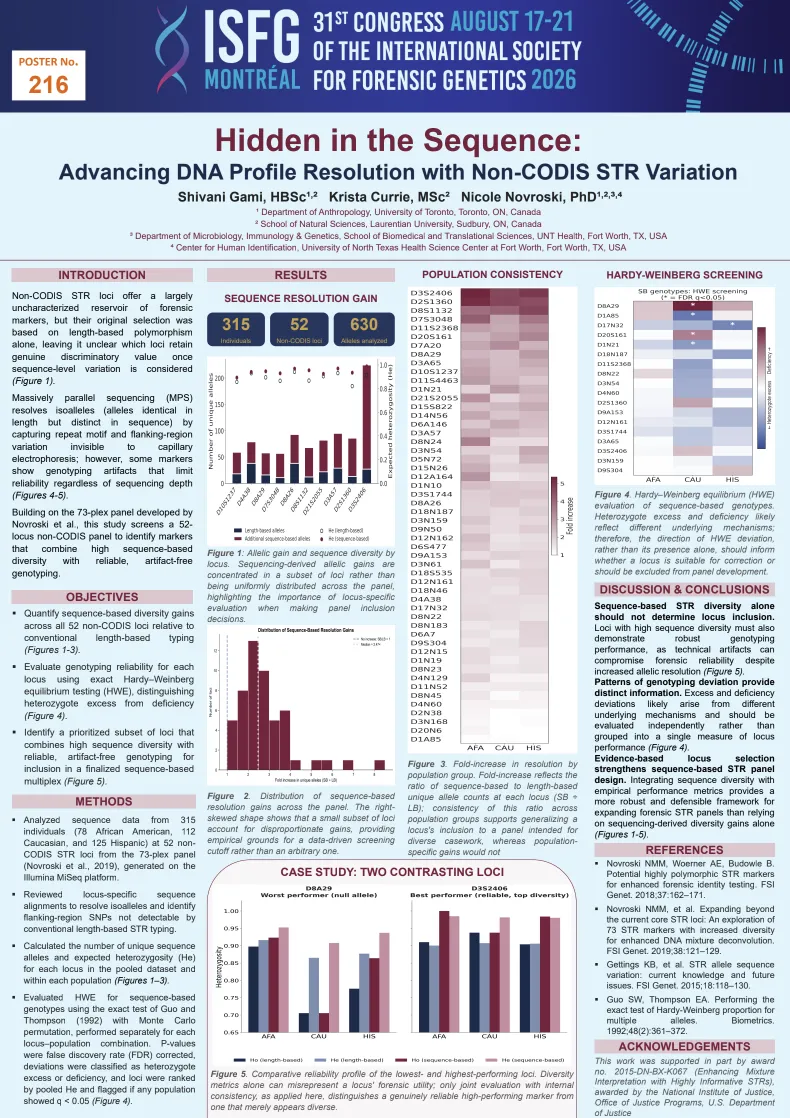
At the ISFG Congress, Gami shared research aimed at solving one of forensic science's persistent hurdles: degraded or compromised DNA evidence. Standard forensic profiling looks at length variations across 21 designated Combined DNA Index System (CODIS) sites in human DNA. When evidence is aged, environmentally damaged, or exposed to cleaning chemicals, these traditional markers can fail to deliver a full profile.
Gami’s research explores an additional layer of information by studying 52 Short Tandem Repeat (STR) markers outside the standard CODIS set across 315 individuals. Using Massively Parallel Sequencing (MPS)—also known as Next-Generation Sequencing (NGS)—she is examining variation within the DNA sequence itself to evaluate whether these additional markers provide greater resolution when distinguishing between individuals.
“Traditionally, we have looked at how long a DNA marker is, but two markers that appear to be the same length can actually have different sequences,” says Gami. “With newer sequencing technologies, we can see those differences that were previously hidden. By reading the actual sequence of letters—the A, C, T, and G building blocks—and looking at both additional markers and sequence-level variation, we have the potential to make a DNA profile even more informative and precise.”
The conference also provided a personal full-circle milestone. Among the global experts in attendance was Dr. John Butler, the renowned forensic geneticist whose textbooks Gami studied early in her education. Years after first discovering forensic science through television, Gami found herself presenting her own research within the international scientific community—complete with Dr. Butler making an unexpected, lighthearted appearance photobombing the background of her poster display photo.
Co-supervised by Krista Currie, Lecturer in Laurentian's School of Natural Sciences, and Dr, Nicole Novroski, Associate Director & Associate Professor at the Center for Human Identification at UNT Health Fort Worth, Gami credits her strong mentorship with preparing her for high-level academic research.
As she prepares to submit her master’s thesis, Gami plans to continue working on molecular biology research before pursuing her Doctor of Philosophy in forensics.
Continue reading

Laurentian University Previews 12th Year of Intercultural Ride-Along Initiative
As community partners prepare for the 2026–27 cohort of the Intercultural Ride-Along and Job Shadow ...
Oct. 15, 2026
Read more

Laurentian Welcomes Fall 2026 Faculty Cohort
Laurentian University is welcoming new professors this fall with the addition of nine faculty member...
Oct. 14, 2026
Read more

Laurentian Earth Sciences Student Shares Impact of Donor Support and Marsh A. Cooper Award
For Inelia Garand, an undergraduate student at Laurentian University’s Harquail School of Earth Scie...
Oct. 13, 2026
Read more
News
Laurentian University closes 2025–26 fiscal year in stable position, launches 2027–2028 budget proce...
Laurentian University has officially closed its 2025–2026 fiscal year, with the institution continui...
Oct. 09, 2026
Read more

How Donor Support is Shaping Architecture Student Michelle Zephyr’s Journey at Laurentian
For Michelle Zephyr, pursuing her passion for architecture has been an international journey across ...
Oct. 08, 2026
Read more
More to Explore
Explore Laurentian University

Study at Laurentian University

Browse Services and Support
