
Field Practicum Hub
If you are ready to begin your field practicum, this is the place for you.
Aanii Boozhoo, Greetings, and Welcome to the Indigenous Social Work Field Practicum Hub!

What is a Field Practicum?
Laurentian University’s School of Indigenous Relations collaborates with various social service agencies to provide third and fourth-year students with valuable field education experiences.
The degree requires 700 field practicum hours in two settings: 300 hours in the third year and 400 hours in the fourth year, with one practicum in an Indigenous agency and the other in a non-Indigenous agency, chosen by the student. Practicum settings include hospitals, schools, family and child centres, etc., with opportunities nationwide.
While an Agency List is available, students may source their own practicums, and are encouraged to establish connections with Indigenous communities. Flexibility is essential as practicum availability varies, and the school cannot guarantee top choices. Detailed information on the application process and everything that follows can be found below!

Application Process
For students who intend to register for Field Instruction I or II and have completed all prerequisite courses, you are required to submit a Student Field Application.
Field Applications must be submitted six months in advance.
Please ensure your Field Application is submitted by the appropriate deadline to allow sufficient time for practicum coordination, especially if you reside outside the Sudbury area.
- For September placements: Applications are due by March 1.
- For January placements: Applications are due by July 1.
- For May placements: Applications are due by December 1.
A completed application includes:
- Completed Student Profile
- Declaration of Acceptance of the Requirements and Expectations of the Indigenous Social Work Program.
- Student Declaration of Understanding - Workplace Safety Form.
- Completed Field Application submitted to the Field Office.
- A copy of your resume and any necessary forms submitted to the DropBox.
For help finding a suitable agency for you placement refer to the agency list

Practicum Courses
Field Instruction I
Field Instruction I
Course code: ISWK 3605 EL
Department: School of Indigenous Relations
Credits: 6.00
This course is for those completing their first 300-hours of supervised field education in an approved social service setting.
The student may choose to do Field Instruction I with an Indigenous agency or non-Indigenous agency as long as both requirements (the Indigenous and non-Indigenous placement) are completed by the end of the program.
Students have the following options when registering for Field Instruction I:
Fall/Winter Session – While registered with a fall start date, the field practicum begins in January (3 days per week) and runs until March. This allows time for students to complete the first half of ISWK 3305 Indigenous Theories and Perspectives in Social Work Practice I. Please note, all practicum students must complete at least the first semester of ISWK 3305 before beginning their practicum.
Spring Session – This practicum runs from May to July (4 days per week).
Field Instruction II
Field Instruction II
Course code: ISWK 4605EL
Department: School of Indigenous Relations
Credits: 6.00
This course is for those completing their final 400-hours of supervised field education in an approved social service setting.
The practicum type for Field Instruction II (Indigenous or non-Indigenous) will be determined by what practicum type was completed for Field Instruction I.
Students have the following options when registering for Field Instruction II:
Fall/Winter Session – This practicum runs from September to December (4 days per week).
Spring Session – This practicum runs from May to July (5 days per week).
Prerequisites and Course Sequencing
To register for Field Instruction I (ISWK 3605EL) students must complete Year 1 and Year 2 course requirements AND the first semester of ISWK 3305EL Indigenous Theories and Perspectives in Social Work Practice I.
To register for Field Instruction II (ISWK 4605EL) students must complete Year 1, Year 2, and Year 3 course requirements.
For further details about program requirements, please visit the Indigenous Social Work program page: Program Details
If you require additional support, you may send a copy of your Academic Summary to the School of Indigenous Relations at sir@laurentian.ca and request a Plan-of-Study.
Important Dates
For important dates please refer to the following link: Field Dates
Special Applications
Paid Practicum Application
Paid Practicum Application
Upon approval, some students may be entitled to complete their practicum while being paid. While this is not a typical occurrence, some students are granted the opportunity through their current/previous employer or volunteer experience.
- Students may complete their practicum in a paid position; however, the role must be different from their current employment duties to ensure a new learning experience.
- Students also need a BSW or MSW supervisor who has not previously supervised them. If that cannot be arranged, the current supervisor must understand that the field placement must be from a learning position, not an employment one.
- The staff at the Field Education Office are not responsible for sourcing paid practicums for students but are required to process paid practicum applications upon request.
If you think you may have the option to complete a paid field practicum, please complete the following:
- Contact your Field Coordinator (in advance) to allow for sufficient time for assessment of the practicum.
- Submit a Student Field Application
Submit the following information to: sirfield@laurentian.ca
- Submit a Policy for Paid Placements Form
- Submit a copy of work/volunteer history with the organization and job descriptions of positions held.
- Submit in writing a description of the proposed field practicum and the role of the student in this practicum.
Please also review the Field Education Manual (p. 30) for important details on Agency requirements for paid practicums.
Challenge Application
Policy for Challenging of Indigenous Social Work - ISWK Courses
PURPOSE
To establish a standard policy regarding requests for challenging the ISWK- 3605 field course and to acknowledge previous studies and relevant experience where appropriate. A student may apply to challenge ISWK 3605 – Field Instruction I
No other ISWK Courses may be challenged.
CONDITION
Requests for a challenge will be considered with the following conditions being met:
- The applicant must possess a minimum of five (5) years relevant paid human service experience.
- The applicant must provide an updated resume with three (3) employment references who can verify relevant experience as described above.
CONCLUSION
This policy is created with flexibility, respecting the knowledge and skills previously acquired by our students, while preserving program credibility.
Decisions on the challenge is made with fairness and caution in accordance with course curriculum and academic expectations.
COSTS
Each challenge request must be accompanied by payment before the application process may commence. Payment may be provided by cheque or money order - one cheque or money order is to be made out to the Laurentian University in the amount of $500.00. The total cost for the challenge is $500.00 non-refundable upon approval of the challenge request.
INSTRUCTIONS
Students applying to challenge ISWK-3605 MUST NOT REGISTER for the ISWK-3605.
Application to challenge is submitted directly to the Field Coordinator.
Challenge Application Process
Upon receipt of the Challenge Application Form, the process is as follows:
Step I
Application is reviewed to ensure the criteria for application is met.
If the application criteria are not met, the challenge process is stopped, the student is notified, and the funds are returned.
If the application criteria are met, then employment References are verified and the application fees are processed.
Step 2
Application is then brought to the next scheduled Faculty Meeting for review and assignment of a Faculty member who will mark the challenge assignment.
Step 3
Once a faculty member has been assigned, the student is contacted via email, provided their Challenge Assignment instructions, information concerning the university policy for extensions, and a letter outlining;
- the course being challenged
- instruction guidelines for the Challenge Assignment
- deadline date for Challenge Assignment submission (1 month is provided to complete the assignment)
Step 4
A copy of the Challenge assignment is provided to the assigned Faculty member
Step 5
Upon receipt of the Challenge Assignment Instructions, the Field Coordinator prepares the student with the Challenge information as required. Challenge Assignments instructions, and completed Challenge Assignment submission is then provided to the assigned Faculty.
Challenge Assignments are marked on a pass or fail basis, with a passing mark being “S” for satisfactory, or “F” for fail. Grade and Challenge Assignment feedback are provided in writing to the student by the Field Coordinator. The Grade is forwarded to the Office of the Registrar where the assigned mark is posted to the student’s Academic Record.
NOTE: If a Challenge Assignment is failed, the student must register and complete the course.
Choosing an Agency
What goals come to mind? Would you like to pursue a career in child welfare, domestic violence support, mental health, addictions, community support, patient navigator, housing or income assistance? There are several practicum opportunities available to students of the Indigenous Social Work Program. Have a look at our Agency List by clicking the button below.

What to Expect During Your Placement
In addition to your responsibilities to the agency during your social work practice, you are required to meet field education expectations
Key requirements include:
- Developing a learning contract
- Submitting weekly field journals
- Tracking practicum hours
- Providing feedback
- Completing other assigned tasks
- Attend mandatory field seminars
As staff at the field office, we also have several responsibilities to you! Find important information below regarding the roles and responsibilities of your field practicum.
Roles and Responsibilities
Your field practicum is a team effort between you and the field education staff. Everyone has a role to play in making sure you have a positive and meaningful experience.
Student (You)
- Work with your Field Instructor/Consultant to identify your learning needs
- Complete required forms and develop your learning contract
- Get to know your placement agency (mandate, framework, etc.)
- Follow school and agency policies and uphold social work values and ethics
- Build professional, respectful relationships
- Complete required coursework
Field Instructor
- Acts as your main support in the practice setting
- Helps connect classroom learning to real-world experience
- Provides guidance, problem-solving, and ongoing support throughout your practicum
Field Consultant
- Works with you and your Field Instructor to support your learning
- Stays in regular contact and helps track your progress
- Participates in evaluations and provides feedback
- Can help reassess priorities if needed
Field Coordinator
- Supports the overall field education process
- Acts as a liaison between students, the school, and agencies
- Reviews your field application and may meet with you to discuss placements
- Manages administrative tasks (agreements, confirmations, requirements, etc.)
The Learning Contract
Developing the Learning Contract
Before You Begin:
- Review the ISWK Field Manual.
- Review any agency material such as the agency mission/mandate, theoretical framework, services offered, etc.
- Review the learning objectives for your specific practicum course (third or fourth year).
- Review the Learning Contract outline.
Brainstorm:
- Think about the goals you would like to achieve during your field education.
- Think about what activities you can complete to meet the agency mandate(s) and course objectives.
- Think about what skills you would like to practice or what knowledge you would like to improve upon.
Completing the Learning Contract:
- Fill out the personal information section, goals, and purpose for your field placement.
- Review objectives 1 and 2 (that are completed for you) and their corresponding activities.
- Review objective 3 AND develop corresponding activities (in point form).
- Develop at least one more objective. You may develop more if you wish.
- List each activity you will complete to achieve the objectives.
Objective Tips:
- You may want to include references to relevant professional documentation skill-building.
- You may want to include relationship building skills.
- You may need an objective descibing how you will link social work theory to practice.
- You may want to create a self-care plan.
Due Date:
The Learning Contract should be completed as soon as possible and uploaded to DropBox so it can be discussed in the Learning Contract Review Meeting. This meeting is normally held in the 3rd week in the beginning of the semester.
If you are still unsure of how to complete your contract you may attend a field application workshop. The date/time of this workshop will be shared through email.
Field Journals
Field journals are a space to reflect, ask questions, and make sense of your experiences. While they aren’t formally graded, they do count toward your overall performance and participation. You’ll usually submit one per week (or every 30 hours if you’re part-time).
What to Include
Learning Contract Activities
- List what you did during the week (point form is fine)
- Connect your activities to your learning contract goals
- This helps track your progress and see if anything needs adjusting
Concerns
- Share any questions or concerns that came up
- For urgent issues, reach out to your Field Instructor directly
Reflective Learning
- Reflect on your thoughts, feelings, and reactions to your experiences
- Connect your personal and professional development
Theoretical Framework of Agency
- Describe how your work connects to the agency’s theoretical approach
- This could include perspectives like ecological, systems, structural, or others
Journal Examples
Tracking Hours
Tracking Hours
As part of your Field Education responsibilities, students are required to keep track of their field practicum hours.
Please use the following Field Education Schedule of Hours form to complete your entry at the end of each week. Be sure to include the cumulative total of hours as you go. At the end of your placement, you will submit the completed form to your Field Instructor for final approval.
Field Seminars
Field Seminars
During third- and fourth-year field practicums, students are required to attend four mandatory field seminars. Third-year field seminars are similar to orientation in that they help the student prepare for fieldwork.
Seminars are mandatory as they are a critical component of a successful field practicum. Students who are absent for their scheduled seminar will be required to complete a make-up assignment or risk not completing the required components of their field education. Please note, they do not count towards field practicum hours.
Field seminars are currently held on Zoom. You will be invited to attend the meeting via your Laurentian email, so keep an eye out for this email towards the start of the term. Seminar dates and times will also be posted on D2L.
Zoom Meetings
At the time of the meeting, sign into Zoom using your LU email and password so we can be sure that your attendance is recorded. If you are not familiar with the Zoom application, please view the Zoom Tutorial beforehand at https://zoom.us
Student Resources: Everything You May Need In One Place!
Field Student Resources
- ISWK Field Manual - A comprehensive document about everything related to ISWK field placements
- Field Education FAQs
- ISWK 3605 & 4605 Practicum Checklist
- Field Application - Situating Self
- Important Field Dates to Remember
- Agency List
- Field Handbook
Forms
- Initial Field Application
- Field Team Roles & Responsibilities
- ISWK 3605 Journal Submission Outline
- ISWK 4605 Journal Submission Outline
- Learning Contract Outline
- Mid and Final Evaluation Agenda Form
- ISWK 3605 Mid-Term/Final Evaluation Criteria
- ISWK 4605 Mid-Term/Final Evaluation Criteria
- Field Schedule of Hours
- Student Feedback Form
Still have questions? We are here for you! Meet the Team:
Sheri Cecchetto, BISW Field Coordinator
Monique Levesque, RSW Field Coordinator
Field Practicum Policies and Procedures
There are several policies and procedures to be aware of before you begin your field education, especially as it pertains to confidentiality, special needs, and professional suitability policies.
Practicum Policies and Procedures
Field Education Breakdown Protocol
Once a field placement has begun, it is expected that the student will complete the required hours in that agency. There are, at times, situations in which it becomes apparent that there are problems that have the potential to affect the viability of the field placement and/or the student's grade. The School of Indigenous Relations recognizes that these problems can be very stressful. Students are encouraged to seek support and guidance immediately. The first lines of communication should be with the Field/Faculty Consultant and/or the Field Coordinator. In situations where that is not possible, contact the Director of the School.
PROCEDURES:
- The Field Consultant will convene a meeting with the student, the Field Instructor and, when necessary; the Field Coordinator. It is strongly recommended that the meeting be held within five working days of notice of a problem.
- The student and the Field Instructor are asked to prepare written reports detailing the nature of the problem. These reports will become the subject for review and discussion during the meeting.
- Each member of the Field Placement Team (see Roles & Responsibilities Form) will be asked to identify possible solutions.
- The decisions reached at the meeting are recorded.
- The Field Consultant will prepare a final report within five working days.
- Copies of the written reports and decisions must be sent to the student, the Field Instructor, the Field Coordinator and to the student file.
- Each member of the team is encouraged to review the documentation and provide additional information if appropriate.
- The Field Consultant will convene additional meetings as necessary.
When problems are identified in a field placement, they may form the basis for one or more of the following:
- Inquiry and review
- Enhanced monitoring of field placement
- Increased support, supervision/instruction
- Increased requirement of hour
- Revision of the learning contract
- Additional assignments
- Removal from a placement
REMOVAL FROM A PLACEMENT
The student may be removed from a placement under the following conditions:
- The field placement setting has requested a removal.
- The Field Consultant, in consultation with the student/and or the Field Instructor, makes the decision to remove the student.
UNSUITABILITY OF FIELD PLACEMENT
If through no fault of the student, a field placement must be discontinued, every effort will be made to reassign the student to another field placement setting as expeditiously as possible. Every attempt will be made to minimize the loss of accumulated placement hours.
The Field Coordinator in consultation with the Field Consultant, Field Instructor and the student will determine what conditions must be in place before the field placement setting can host another field placement.
UNSUITABILITY OF STUDENT
The termination of a placement resulting from the student’s inability to meet the course requirements, placement expectations, professional obligations, and/or standards of ethical practice may form the basis for one or more of the following:
- Grade of incomplete or fail;
- Full or partial loss of accumulated hours;
- Waiting period before resuming another field placement;
- Directed field placement;
- Information sharing with prospective Field Instructors;
- Inclusion of learning goals related to placement breakdown;
- Enhanced monitoring of next field placement;
- Increased support, supervision/instruction;
- Suspension from the Bachelor of Indigenous Social Work program.
TRANSFER TO A NEW PLACEMENT SETTING
Requests for a transfer out of an assigned field placement will be considered only when there are exceptional circumstances and all other reasonable options have been exhausted. The procedure for transferring is as follows:
- The Field Consultant must submit Request for Transfer and any supporting documentation to the Field Coordinator.
- The student must submit a new application for another field placement to the Field Coordinator.
- The Field Coordinator will review the submission and complete a new placement search accordingly.
TRANSFER OF ACCUMULATED PLACEMENT HOURS
When a transfer to a new placement setting is required, there may be a full or partial loss of accumulated placement hours. The number of hours lost OR transferred is dependent upon several factors. They include, but are not restricted to, the following:
- The reasons underlying the request for transfer of hours;
- The recommendations of the Field Consultant, Field Coordinator and the student;
- The requirements of the new field placement setting;
- The time required to achieve learning goals in a new setting;
- The time required to provide meaningful evaluation of learning goals in a new setting;
- Availability of resources.
SUSPENSION FROM THE PROGRAM
“Students will be required to withdraw from the University if they have been enrolled in a professional program, have been required to withdraw from it and have not been permitted to transfer to another program. The School of Indigenous Relations, Honours Bachelor of Indigenous Social Work, through its faculty and appropriate committees, reserves the right to suspend a student, who notwithstanding their academic performance, fails to adhere to ethical and professional standards incumbent upon members of a helping profession.”
- All parties are required to follow the School of Indigenous Relations – Honours Bachelor of Indigenous Social Work procedures for Field Education Breakdown Protocols. In situations where the process results in a recommendation that the student be suspended the procedure is as follows:
- The Field Consultant notifies the Director and provides the Director with all pertinent documentation.
- The Director will convene a meeting with all relevant parties for the purpose of reviewing the documentation. They will provide the participants with an opportunity to submit any additional information.
- The Director will convene a meeting that will include the Director, the Field Consultant, the Field Coordinator and at least two other faculty members.
- It will be the responsibility of this committee to assess the information, interview people as required and proceed with a decision in a timely manner.
- The Director and the Field Coordinator make the final decision and notify the relevant parties of the decision.
- The Director and the Field Coordinator notify the Office of the Registrar of any suspensions.
- As with any other decisions, the student has the right to appeal (i.e. Laurentian University student appeal policy) the decision to suspend.
Determining Misconduct and Imposing Sanctions
The School of Indigenous Relations reserves the right to expel a student from the Indigenous Bachelor of Social Work program who, notwithstanding their academic performance, fails to adhere to ethical and professional standards incumbent upon members of a helping profession.
Examples of misconduct may include (but are not limited to):
- Concealment or distortion of the truth
- Harassment or any threat, intimidation or attempt to harm another person
- Persistent and/or serious unethical behaviour which interferes with the ability function within a professional context (as defined above) including but not limited to
- Evidence that a student cannot effectively exercise judgment or function in a professional context, such as:
- Persistent or serious inability to form professional relationships;
- Discriminatory behaviour and lack of reflexivity about behaviour, or lack of effort to change behaviour identified as discriminatory;
- Abuse or misuse of substances that interferes with the ability to function within a professional context;
- Criminal behaviour (a charge and/or conviction for crimes such as physical assault, sexual assault, drug trafficking, for which a pardon has not been received) which would interfere with the ability to function within a professional context;
- Serious conduct that contravenes the policies of the University or of a field placement setting which cannot be resolves through negotiation or reassignment.
The first steps in dealing with any concerns about student behaviours and suitability should be through informal discussion between the student and faculty or field instructor. Should the concerns not be resolved or be of serious nature, it may become necessary to review them more formally.
INFORMAL REVIEW
The faculty and / or field instructor will first request a meeting verbally or in written form (email or letter) with the student to discuss the concerns. This meeting may result in:
- A better understanding of the behaviours in question and need no further action.
- A plan outlining actions the student will take to address the concerns, along with a date to review the student’s progress.
- A decision to proceed with a more formal review of the situation.
- The Faculty or field instructor will summarize the results of the meeting in writing and provide the student with a copy. A copy will be placed in the School’s student’s file placed in the School’s student’s file.
FORMAL REVIEW
A formal review of a student’s suitability for Social Work shall be requested in writing by the faculty member or field instructor. The Director also may initiate the process in writing on behalf of the School.
- Written Request: The written request will be addressed to the Director, with a copy to the student. When a field instructor requests a review, the Field Coordinator will be notified and consulted. The written request will outline the concerns about the student’s suitability for the School of Indigenous Relations /Honours Bachelor of Indigenous Social Work program. For standards relating to policies outside the direct responsibility of the School (as outlined above), officials from those departments will be consulted so that they may assist in explaining their policies and implementing sanctions under their jurisdiction, if deemed necessary.
- Timing of review: The formal review shall be held within 3 to 4 weeks and be chaired by the Director or delegate. The student, faculty and/or field instructor involved shall attend the meeting. Other persons may be asked to attend the meeting, including persons who have relevant information to contribute to the discussion. The student may choose to have a person accompany them as observers or support. Should the student not be responsive to requests for the meeting despite several attempts, the Chair may proceed with the meeting in absence of the student.
- Review of documentation and information: The meeting’s purpose is to review relevant concerns about the student’s suitability in the School. Relevant documentation will be reviewed, and individuals with relevant information to the concerns may contribute to the discussion. The student will have the opportunity to ask questions and to present their position. Suggestions regarding possible remedies or sanctions will be discussed.
- Course of action: Following conclusion of the review, the Director or delegate will decide on a course of action. A letter (by email or post) summarizing the reasons for the decision and any plans will be provided to the student within 2 weeks. A copy will be placed on the student’s file. The Director will notify the Office of the Registrar of any actions or expulsions from the Indigenous Social Work program.
APPEALING A DECISION TO SANCTION
Students have the right to appeal a decision by the School of Indigenous Relations to sanction or expel them. In all cases, the School of Indigenous Relations will refer to relevant sections of Laurentian University’s Student Appeals Policy in place at the time.
Special Needs Policy
- Policy on Accessibility Standards for Customer Service (PDF)
- Policy on Academic Accommodation for Students with Disabilities (PDF)
- Guidelines for Academic Accommodation for Students with Disabilities (PDF)
Social Media Policy
Laurentian University's Social Media Handbook
Electronic Services Acceptable Use Policy
Professional Suitability Policy
Honours Bachelor of Indigenous Social Work Professional Suitability Policy
April 19th, 2017
RATIONALE
The Canadian Association of Social Work Education (CASWE) Standards for Accreditation 2014 (SB 2.4.5) requires that “The academic unit has a policy regarding the professional suitability of the student for the profession of social work. Students are made aware that serious or repeated violations of the Code of Ethics put them at risk of exclusion from the program based on professional unsuitability.” This Professional Suitability Policy addresses those requirements of the CASWE Standards of Accreditation.
OVERACHING PRINCIPLES
CASWE expects that Schools of Social Work should graduate social workers whose behaviours are consistent with social work ethics and values, to ensure that social workers do no harm to service users and communities. The overarching values guiding these behaviours include:
- Respect for the Inherent Dignity and Worth of Persons
- Pursuit of Social Justice
- Service to Humanity
- Integrity in Professional Practice
- Confidentiality
- Competent Application of Knowledge and Skills for Professional Practice
The School of Indigenous Relations at Laurentian University has developed the following policy as a requirement of its accreditation with the CASWE, recognizing its responsibility to ensure safety and well-being of students, staff, faculty members as well as the clients and staff of those agencies in which students carry out their field placements.
In implementing this policy, the School of Indigenous Relations will remain sensitive to each case brought to its attention to understand the context of the behavior deemed unsuitable or unethical and will ensure that it not excluding students without critical regard.
The School also recognizes that the safety, confidentiality and self-determination of students or others who have been subjected to unprofessional conduct under this Policy must be an important priority. Personal information collected by the University shall only be disclosed and used in accordance with the University’s duties and obligations under the Freedom of Information and Protection of Privacy Act (FIPPA).
In developing a response to a concern about student suitability, the School will balance confidentiality against its duty to protect existing and future students or persons who might otherwise be placed in jeopardy by a student who is acting in an unprofessional manner under this Policy.
It is important that students review and become familiar with the responsibility areas, such as the CASW Codes of Ethics, University policies and procedures governing student behaviour, and School of Indigenous Relations Sacred Teachings. Students are required to sign the Student Declaration Form when entering the program, indicating that they have read and understand the Professional Suitability Policy and standards.
The School of Indigenous Relations will consult with other departments/offices (indicated below) should concerns about student behaviours relate to policies outside of the School’s responsibility. Those departments or offices will determine their own sanctions according to their policies.
The School of Indigenous Relations is responsible for implementing student suitability standards relating to the following:
- Indigenous Sacred Teachings - Seven Gifts, Medicine Wheel and Trust Teachings (See ISWK Field Education Manual, 2022, p.21)
- Canadian Association of Social Workers (CASW) Code of Ethics
- Ontario College of Social Workers and Social Service Workers (OCSWSSW) Code of Ethics and Standards of Practice
Laurentian University’s Office of Student Life is responsible for implementing suitability standards relating to the following policies:
- Code of Student Conduct, Non-academic
- Code of Student Rights and Responsibilities
- Policy on Social Media
- Electronic Services Acceptable Use Policy
Laurentian University’s Office of Equity, Diversity and Human Rights is responsible for implementing suitability standards relating to the following policies:
Confidentiality Policy
Students while in placement (whether paid or unpaid) are required to abide by the Ethical Conduct, Indigenous teachings, privacy and confidentiality, all relevant policies (which includes Indigenous Ethics, CASW, OASSW and relevant Laurentian policies) and the relevant agency policies. Students must sign the Declaration of Agreement form (found in the Forms Section of this fieldwork manual) before they start any field placement. Students are taught in the field seminars and theory courses ISWK 2315, 3305 and 4305, issues about ethics and confidentiality as relevant to practice and field.
People trust you to maintain confidentiality at all levels whether it is with individuals, family, community or workplace. Once trust is broken, people have a difficult time to re-establish trusting relationships. Therefore, trust underpins confidentiality.
Definitions
- School - The School of Indigenous Relations
- Participants - Any person or body that is part of or interacts with the School
- Students - Students of the School
- Staff - The faculty, and professional and administrative staff of the School
- Body - Includes a subcommittee, a committee, other administrative groupings, other institutions (i.e. placement agencies, accreditation bodies)
- Placement agency - Setting in which the student carries out a fieldwork education experience
- Information or personal information - Recorded information about an identifiable individual which includes, but is not limited to identifying data, others’ opinions about an individual, an individual’s personal views or opinions.
- Privacy - Refers to persons and to their interest in controlling access of others to themselves
- Confidentiality - Refers to data, and about agreements and procedures for limiting the access of others to data
- Confidential - To keep private or secret, safe from access, use or disclosure by people who are not authorized to handle the personal information
- Field Team - Field Coordinator, Student, Agency Supervisor, Field Consultant
Applicability of Confidentiality Policy
The Confidentiality Policy applies to:
- All registered HBISW students in the program (both on-campus/Distance Education)
- Those students, faculty and staff of the School who are involved in Field Education Placements
- Field Education Placement Agencies
Responsibility for the Application of Policies
The Director of the School is ultimately responsible for ensuring the respect of all policies.
Each individual, group and body that interacts with the School for Field Education Placements is responsible for upholding their role and responsibilities as outlined in the policies.
Objectives of the Confidentiality Policy
- To provide a field education placement in which the clients and staff of the placement setting are guaranteed respect and security of their privacy and confidential information.
- To ensure the ethical conduct of students of the School while on a field placement in a supportive climate of trust, openness, transparency, security and belongingness during the Placement.
- To respect Indigenous communities, the Medicine Wheel and the Indigenous Code of Ethics – The Seven Gifts used to frame paradigms of privacy and confidentiality with those of 1) CASW, 2) FIPPA and the 3) Laurentian University.
- To ensure that a set of policy statements that frames and meets the ethical conduct, privacy and confidentiality needs of the above (3) in all participant relationships and information exchange and storage, during a Field Education Placement.
Confidentiality Processes:
- The Confidentiality Policy is guided by and upholds three sets of practice guidelines:
- The Medicine Wheel Teachings and the Indigenous Code of Ethics – The Seven Gifts;
- The CASW Codes of Ethics and Standards of Practice, and policies on Confidentiality and Privacy
- The Freedom of Information and Protection of Privacy Act (FIPPA)
- All members (Field Instructor/Student/Field Consultant) are required to adhere to the confidentiality requirements outlined in the CASW and The Indigenous Code of Ethics – The Seven Gifts.
- All Placement Agencies and their clients are to be guaranteed that their personal privacy is respected and their personal information is confidential, so as to participate in the field education placement agency in a climate of trust, openness, transparency, security and belongingness.
- Participants (clients and Placement students) must be able to respect the personal information of others and not feel obligated to disclose any personal information against their wishes. Anyone with knowledge of personal information related to the privacy of another must not disclose such.
- All students are to uphold and respect agency policies and their clients’ personal privacy, and ensure that their personal information is kept confidential.
- All students are to uphold and respect the CASW and OASW Codes of Ethical Conduct and standards of practice.
- All students are to uphold and respect their Placement Agencies policies for ethical conduct, privacy and confidentiality.
- All Placement students will have opportunities to gain an understanding and awareness of all matters and issues related to ethical conduct, privacy and confidentiality, both in terms of the practice of Social Work and the assurance of such within the Field Education Placement.
- This will be prior to and at the beginning of a Field Education Placement for all participants in such.
- The above will be followed by all participants signing this Agreement of Ethical Conduct, Privacy and Confidentiality.
Confidentiality requirements are conveyed to students by:
- Students being required to attend Field Seminars where explanations of procedures of the Code(s) of Ethics outlined in this Field Placement Manual and confidentiality are discussed.
- The Fieldwork Confidentiality Policy is given to each member of the Field Team (including the Student, Field Instructor and Field Consultant) by the Field Coordinator. All individuals must sign the Agreement of Ethical Conduct, Privacy and Confidentiality before the field placement can begin and return it to the Field Coordinator.
The Field Coordinator is required to:
- Ensure that the student and Agency Supervisor are aware of the confidentiality requirements of the profession.
- Ensure that all members of the Field Education Team have access to the CASW and Indigenous Social Work – The Seven Gifts.
Members of the Field Education Team are required to:
- Review the confidentiality requirements of the profession and of the field placement setting at each Field Consultation Meeting.
- Ensure that the confidentiality agreements are understood, signed and practiced.
- Ensure that field placement assignments such as journals, videos, etc. safeguard the standards of confidentiality.
Faculty Members in the School of Indigenous Relations are required to:
- Ensure that any assignments, material, information and/or discussions pertaining to field placement educational experiences conform to confidentiality standards.
Breach of Confidentiality Policy
Any breach of ethical conduct, privacy or confidentiality by a student within a Fieldwork Education Placement shall be brought to the attention of the Field Consultant for action.
A first breach will result in a discussion with the Instructor as to reasons and impacts. If a suitable understanding of the seriousness of the matter is achieved, with agreement to correct future behaviour, the matter will be considered closed.
If in the judgment of the Field Consultant, the matter is not considered closed or resolved; or in a second breach, disciplinary action will be taken. The Field Consultant with inform the Field Coordinator. The Field Coordinator will consult with the Registrar. Findings from this consultation will be brought to the Faculty/Staff Committee consisting of the Field Coordinator, Field Consultant and Director of the School and the Student. Possible removal from the Placement and expulsion from the program may result.
Interpretation
The Field Consultant will take issues of interpretation or application of this policy to the Director, Faculty/Staff Committee, whose decision is final.
Values and Ethics
As social workers, we all must follow a set of core values, ethics, and standards of practice to ensure we are practicing safely, ethically, and with integrity while providing helping services. As you may come to realize, the Indigenous Code of Ethics is closely correlated to the values embedded in the CASW and OCSWSSW Code of Ethics.
The Seven Gifts
Relevant Indigenous Social Work Competency Criteria and Social Worker Declarations

Nbwaakaawin • Wisdom
Social Worker Declaration
Responsibility to the profession – I will act to promote excellence in the social work profession. Commentary: Refer to CASW/OASSW Code of Ethics and Indigenous Ethics
Nbwaakaawin – To cherish knowledge is to know WISDOM.
Commentary:
• to earn wisdom by taking time to reflect on everything we experience;
• to acknowledge the opportunity of every lesson learned; to learn a high degree of knowledge; the cumulative culture of the human race.
Value Statement:
“The respect for that quality of knowing and gift of vision in others (striving for the same within oneself) that encompasses the holistic view, possesses spiritual quality, and is expressed in the experiential breadth and depth of life. A person who embodies these qualities and actualizes it in others and translates it for others’ benefit deserves respect as an ‘Elder’.”
(Dumont)
COMPETENCY CRITERIA
The field education setting I have chosen will give me opportunities to learn and develop competency in the areas identified.
Learning Objectives Checklist
1. Know and practice the values and ethics of the profession.
2. Communicate understanding.
3. Know how to conduct awareness and consultation workshops
4. Recognize the importance of research in the human services.
5. Conduct data collection, analyze and know how to use it.
6. Identify and use social networks and resources effectively.
7. Seek guidance from our Elders.
8. Consistently seek to extend knowledge and improve skills.
Zaagidwin • Love
Social Worker Declaration
Primary Professional Obligation – I will regard the well-being of the persons I serve as my primary professional obligation.
Responsibility to the Workplace – I will work for the creation and maintenance of workplace conditions, and policies consistent with the standard of practice set by the policies and codes of conduct in this fieldmanual.
Commentary: Refer to CASW/OASSW Code of Ethics and Indigenous Ethics.
Zaagidwin – To know LOVE is know peace.
Commentary:
• to know how to get along with others and work with people;
• to care;
• to have things in a state of order and harmony;
• to show kindness and cooperation
Value Statement
“Capacity for caring and desire for harmony and well-being in interpersonal relations.” (Dumont)
COMPETENCY CRITERIA
The field education setting I have chosen will give me opportunities to learn and develop competency in the areas identified.
Learning Objectives Checklist
1. Know and understand the field education setting’s mandate, goals and objectives.
2. Know how to use agency resources, policy and procedures.
3. Document effects of social policies on clients.
4. Know how to analyze and promote changes in a policy or procedure.
5. Know the effect of physical setting on client and worker.
6. Apply practice values of acceptance and empowerment.
7. Demonstrate capacity to offer hope and effective support.
8. Develop work management skills; to plan and organize a work plan.
Mnaadendiwin • Respect
Social Worker Declaration
Responsibility to Society – I will act to effect social change for the overall benefit of humanity.
Commentary: Refer to CASW/OASSW Code of Ethics and Indigenous Ethics.
Mnaadendiwin – To honour all of the Creation is to have RESPECT.
Commentary:
• to encourage respect for the diversity of cultures which constitute society;
• to accept cross-cultural differences;
• to have a strong sense of what is right;
• to maintain high standards of conduct.
Value Statement:
“Conscious of the need for kindness and respecting the integrity of oneself and others, to exercise strength of character, fortitude and self-mastery in order to generate and maintain peace, harmony and well-being within oneself and in the total collective community.” (Dumont)
COMPETENCY CRITERIA
The field education setting I have chosen will give me opportunities to learn and develop competency in the areas identified.
Learning Objectives Checklist
1. Safeguard client’s dignity, individuality and rights.
2. Take action to eliminate racism; race relations policy development.
3. Participate in a needs assessment activity.
4. Assess and interpret the needs of the community.
5. Advocate for change in policy and legislation.
6. Ensure all clients have access to the resources, services and opportunities which they
require.
7. Form a meaningful relationship with the community.
Aakde’win • Bravery
Social Worker Declaration
Integrity – I will fulfill my obligations and responsibilities with integrity
Commentary: Refer to CASW/OASSW Code of Ethics and Indigenous Ethics
Aakde’win – BRAVERY is to face the foe with integrity.
Commentary
• to have courage and face difficult situations;
• to acknowledge the ability to go deeper into self-awareness;
• to be strong and achieve completeness in our personal development;
• to maintain strength of character;
• to have self-assurance.
Value Statement
Bravery as strength of character that requires great inner strength and fortitude in situations of great difficulty or personal danger while maintaining self-mastery, control, and the rightful dignity of others”. (Dumont)
COMPETENCY CRITERIA
The field education setting I have chosen will give me opportunities to learn and develop competency in the areas identified.
Learning Objectives Checklist
1. Identify professional development needs and undertake to meet them. Maintain self-awareness; manage personal needs, feelings and values.
2. Demonstrate awareness and understanding of own attitudes and values in the helping process.
3. Plan effectively with consistency, be well-organized and consider priorities appropriately.
4. Demonstrate ability to take initiative; work independently.
Gwekwaadziwin • Honesty
Social Worker Declaration
Confidential Information – I will protect the confidentiality of all professionally acquired information. I will disclose such information only when properly authorized or when obligated legally or professionally to do so.
Outside Interests and the Practice of Social Work – I will ensure that outside interests do not jeopardize my professional judgement, independence and competence.
Commentary: Refer to CASW/OASSW Code of Ethics and Indigenous Ethics.
Gwekwaadziwin – HONESTY in facing a situation is to be brave.
Commentary
• to give or have full worth value;
• to have personal qualities in truthfulness, sincerity and fairness;
• to have respect for other’s and for one’s own personal integrity.
Value Statement
“To act with the utmost honesty and integrity in all relationships recognizing the inviolable and inherent autonomy, dignity and freedom of oneself and others.” (Dumont)
COMPETENCY CRITERIA
The field education setting I have chosen will give me opportunities to learn and develop
competency in the areas identified.
Learning Objectives Checklist
1. Know the policies and obligations of maintaining confidentiality.
2. Know how to manage confidential information.
3. Know how to keep case records.
4. Respect the inner workings and difficulties of a workplace setting.
5. Know how to develop and apply an evaluation strategy.
6. Know how to communicate results of feedback appropriately.
Dbadendizwin • Humility
Social Worker Declaration
Social Worker – Client Relationship
I will respect the intrinsic worth of persons I serve in my professional relationships with them.
Commentary: Refer to CASW/OASSW Code of Ethics and Indigenous Ethics
Dbadendizwin – HUMILITY is to know yourself as a sacred part of the Creation.
Commentary
• to be modest in our actions in the context of helping;
• to have sensitivity toward others;
• to be respectful of our clients’ preferred
• ways of doing things.
Value Statement
“The recognition of yourself as a sacred and equal part of the creation, and the honouring of all
of life which is endowed with the same inherent autonomy, dignity, freedom and equality. This
leads to sensitivity toward others, a posture of non-interference and a desire for good relations
and balance with all of life.” (Dumont)
COMPETENCY CRITERIA
The field education setting I have chosen will give me opportunities to learn and develop
competency in the areas identified
Learning Objectives Checklist
1. Develop self-awareness on personal strengths and limitations.
2. Know that I have the capacity for growth and change; take
a. initiative in self-development and self-evaluation.
3. Use self-disclosure appropriately.
4. Develop listening and observation skills.
5. Allow client self-determination; mutually document needs.
6. Ability to interpret non-verbal communication.
7. Know circumstances where intervention is not appropriate;
8. respecting the ethic of non-interference.
9. Ability to develop a problem solving strategy.
Debwewin • Truth
Social Worker Declaration
Competence and Quality of Service
I will be competent in the performance of the services and functions I undertake on behalf of the
persons I serve.
I will act in a conscientious, diligent and efficient manner.
Commentary: Refer to CASW/OASSW Code of Ethics and Indigenous Ethics
Debwewin – TRUTH is to know all of these things.
Commentary
• the state or character of being true in relation to being, knowledge or speech;
• to be real and natural and have a genuine interest in the human services;
• to be loyal in our human relationships;
• to learn and to adhere to local community and family protocol; to recognize the value of sharing
Value Statement
“Recognizing interdependence and interrelatedness of all of life, to relate with one another with
an ethic of sharing, generosity, and collective/communal consciousness and cooperation.” (Dumont)
COMPETENCY CRITERIA
The field education setting I have chosen will give me opportunities to learn and develop competency in the areas identified.
Learning Objectives Checklist
1. Develop interpersonal communication skills.
2. Work cooperatively with others.
3. Work collaboratively with colleagues; promote teamwork.
4. Know how to apply skills in offering and obtaining consultation
a. and supervision.
5. Know interviewing processes and skills.
6. Planning; establishing goals and objectives
7. Formulate and implement appropriate helping strategies.
8. Know and understand human growth and development as it pertains
a. to all of the seven teachings.

Trust Teachings
Trust Teachings By Elder Herb Nabigon Gii-Nbo
The teachings around trust goes back into our long memories and if you consider the four seasons spring, summer, fall and winter you will begin to trust your memory that the spring will return every nine months. This tells us that the natural clock will be with us for time immemorial. Trusting our memories begins to take shape around relationships with each other.
Going back to spring, if it fails to return, our trust in the Creator will be deeply shattered. The failure of spring time would begin to reflect our trust not only in each other but in the Creator.
Teachings around the Windigo Spirit (dark side)
Windigo can be best understood around the teaching of our dark side of life. The dark side really is best described around our dysfunctions. This teaching around Windigo is described by our Elders as anger. The general term anger can be viewed around the four directions. The negative side of the East: is inferiority, the South: is envy, the West: is resentment and the North: is uncaring. And at the centre of our being is jealousy/not listening. The Elder taught me this is how Windigo controls fear. When our trust is shattered or broken, Windigo takes over and controls fear. Therefore, the Elders view this as a disconnect from the Creator. We need to learn how to manage and control Windigo individually and that takes strength on our part. This is where ceremonies such as pipe, smudging and sweat lodge enable us to have more control over Windigo. It is said that the dark side will always be with us and the Creator created the dark side to help us to learn about the good side.
Teachings around Nanabush (daylight side)
The teaching around Nanabush has many stories. The story around Nanabush is of goodness. We understand that Nanabush is the Creator’s helper. He carries gifts from the Creator. These gifts come from the four directions. From the North is caring, from the East is good feeling, from the South is relationships and from the West is respect. And at the centre of our being is listening which is the opposite of jealousy. Nanabush also carries humour. Humour is used as a way of healing Windigo.
Connecting Trust Teachings to Social Work
Our main focus is the community and we know from experience many families/individuals are experiencing pain around addictions, domestic violence, suicide and general poor health. We are addressing this pain by understanding the teachings around trust. Students learn about the teachings through the Indigenous Human Services courses. Our students tell us about how effective they become when they use these teachings. The most difficult thing for many of our students is moving these teachings from their head to their hearts. They tell us that this is a very long journey to integrate.
Connecting Trust Teachings to Practice
It is generally accepted that the field agency culture embraces Nanabush. However, you might come across someone or an event that manifests Windigo. It is at this point, that you may refer to the Nanabush teachings or seek guidance and/or intervention around Nanabush teachings. So when you are in your fieldwork practice, we encourage students to carry Nanabush teachings and Windigo understanding. This enables our students to walk with the ancient voice of our ancestors.
The Medicine Wheel
Framework for Consideration of Generalized Primary Indigenous Values
From this consideration of the “persistent” values as they have been discerned from various cultures of North American can be generalized certain traditionally-based Indigenous values that appear to be consistent across cultures and across time changes. To view these, we will go back to the Ojibway Anishinabe values initially presented in order to consider these persistent general and primary values in that framework. First let us look at the original design of the four symbolic races:
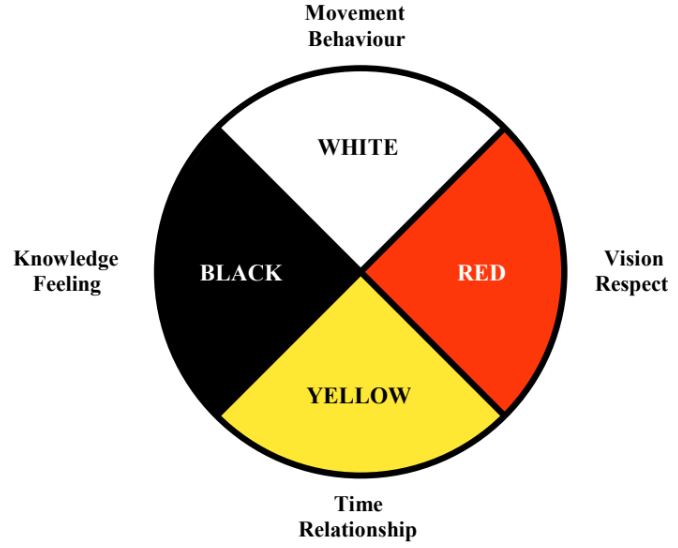
From this the (Anishinabe) or Indigenous person is gifted with the unique quality of vision. This is both their special way of “seeing the world” as a native person, and the capacity for holistic or “total” vision. With this ability to see beyond the boundaries of the physical and the capacity for all-around, circular vision comes respect:
- Respect for creation.
- Respect for knowledge and wisdom.
- Respect for the dignity and freedom of others.
- Respect for the quality of life and spirit in all things.
- Respect for the “mysterious”.
Now, when the foundational four directional principles and the seven values are placed around this central capacity for vision, the design looks something like this:
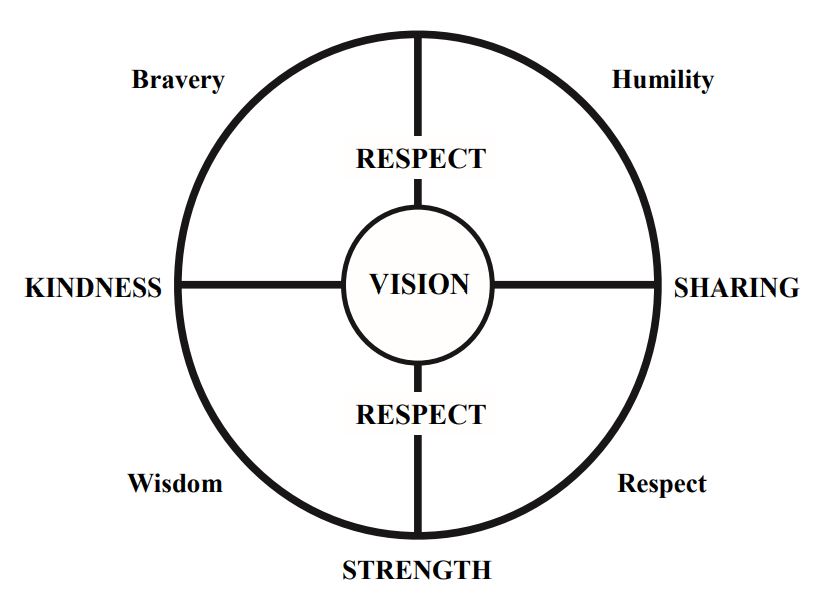
Vision in this design, is the primary generator of the Ojibway value system. Vision is wholeness; it recognizes the interconnectedness of all things and the totality of its interrelatedness, because of this vision generates respect. Respect conditions all other values, thus engendering a unique value system with a unique interpretation and prioritizing of each value.
Values such as wisdom, honesty, humility, kindness and strength, may be claimed equally by other peoples and cultures, however, what makes for the uniqueness of Native values is the perception and understanding of these values because of the primal gift of vision/wholeness and the primary motivation of respect.
Medicine Wheel Teachings Relevant to Fieldwork
The Medicine Wheel is used as the framework to conceptualize helping from an Indigenous Perspective in fieldwork education. The Medicine Wheel teaches us that the four symbolic races are all part of the same human family. All are brothers and sisters living on the same Mother Earth (The Sacred Tree).
The Journey
RED – Gifts of the East
Retrieval
- Entry point for the process of field education.
- Observation and recall; (as observer, the role requires noting circumstance and setting).
- What interaction is demanded of my role as a helper?
Renewal
- Direction for a new beginning.
- A time to reflect on my own life.
- What aspects of communication skills do I want to improve?
Vision
- Vision of my potential, to grow and develop and feel good about myself.
- A vision that becomes the path toward my wholeness.
- The process of developing my uniqueness through the teachings of the Medicine Wheel.
Protection
- The Medicine Wheel.
YELLOW – Gifts of the South
Linkage
- Understanding of theoretical concepts relevant to field practice.
- Concrete situation make it possible to link knowledge.
Relationships
- Sensitivity to the feelings of others.
- What are my strengths and limitations?
- What are my needs and what are the needs of those I am working with?
Knowledge
- My search for professional knowledge
- What are my goals and how do I pursue them?
Nourishment
- The nurturing human beings receive through interactions with the human, physical and spiritual environments.
BLACK – Gifts of the West
Reflection
- Feedback reflecting on my learning objectives.
- Building on the ongoing evaluation of the work accomplished.
Respect
- Regard for and appreciation of cultural differences.
- What is the quality of my inner life?
- What are my values, biases, attitudes, and assumptions?
Self-Awareness
- My identity consisting of:
- Self-concept: What I think about myself and my potential.
- Self-esteem: How I feel about myself and my ability to grow and change.
- Self-determination: My ability to use my volition (will) to actualize my physical, mental, emotional, and spiritual potentialities.
Growth
- The importance of pursuing life experiences which provide positive growth and development.
WHITE – Gifts of the North
Professional Response
- Appropriate levels of interventions I have selected to helping.
- End of journey and beginning of the next.
- End of integration of theory and practice cycle and beginning of the next.
Caring
- My level of intervention within family, school, community and nation.
Accomplishment
- What new skills, new attitudes, new experiences, new ways of living have I acquired?
Wholeness
- The unity and centering of the qualities of the four directions in the human being.
GREEN – A Healing colour and a symbol of Mother Earth
Healing
- The first step towards healing is relearning how to listen to our dark side.
Listening
- How to listen to the dark side of life defined as inferiority, envy, resentment, not caring and jealousy; listening helps us to make the appropriate changes from negative to positive behaviour.
“As we journey around the wheel, reflect on your own qualities and gifts. Certainly, the fundamental value of this tool (the Medicine Wheel) is a way of measuring our own progress and development, and a means of assessing what we must work on in our journey through life”. (The Sacred Tree, p.40)
Sources:
“Justice and Aboriginal People” prepared by James Dumont, B.A., M.Div., Mide II Department of Native Studies, University of Sudbury.
Bopp, J., Bopp, M., Brown, L., & Lane, P. (1984). The Sacred Tree. Lotus Press.
CASW Code of Ethics
OCSWSSW Code of Ethics
Refer to the OCSWSSW Code of Ethics and Standards of Practice
Practicum Testimonials
Attention all HBISW students! Be featured on the Field Practicum Hub!
Are you someone who:
- Is or was an HBISW student?
- Completed at least one practicum?
- Would like to be featured on our website?
- Can provide a photo?
If you have already completed a practicum and would like to submit a testimonial about your Field Practicum experience, you may earn a spot to be featured on this webpage! For more information on submitting a testimonial, please email sirfield@laurentian.ca

Experience. Learn. Share.
The Laurentian University campus offers several ways to discover Indigenous culture, become part of the Indigenous community, or make an impact on students and Indigenous populations. The Indigenous Student Affairs office hosts several events and activities throughout the year such as Biidaabin, Orange Shirt Day, Métis Cultural Day, Nakiiwin Tek, Red Dress Campaign, Moose Hide Campaign, ceremonies, cultural teachings, academic workshops, and mental health awareness. Learn more about Laurentian University’s Indigenous programs and organizations below.
ISWK Student Council
The ISWK Student Council at Laurentian University is proud to represent current and future students of the Indigenous Social Work Program. Follow the links below to learn more or email the student council directly at: iswkstudentcouncil@laurentian.ca

Indigenous Student Affairs
The Indigenous Student Affairs office at Laurentian University supports First Nations, Métis, and Inuit students as they navigate their academic journey. They promote an environment that is positive, holistic, inclusive, and in line with Indigenous worldviews. Get involved or learn more about them by clicking below.

Master of Indigenous Relations
The Master of Indigenous Relations (MIR) offers students the opportunity to gain the skills necessary to make lasting and positive change for Indigenous communities. Expand your knowledge and skills in research, relationship building, policy writing, etc. Learn about the MIR program by clicking the link below.

Maamwizing Indigenous Research Institute
The Maamwizing Indigenous Research Institute at Laurentian University promotes collaborative research about Indigenous people and for the Indigenous people, in line with community needs. Learn more about the Institute by clicking below.

Indigenous Sharing and Learning Centre
The Indigenous Sharing and Learning Centre (ISLC) opened in 2017 to provide a space to enrich and foster Indigenous learning, sharing, and ways of being. It offers a round-room gathering space, ceremonial spaces, seminar room, and much more. Learn more about the ISLC by clicking below.

School of Indigenous Relations
The School of Indigenous Relations offers two programs at Laurentian University: The Bachelor of Indigenous Social Work and the Master of Indigenous Relations. Learn more about these programs by clicking the link below.
